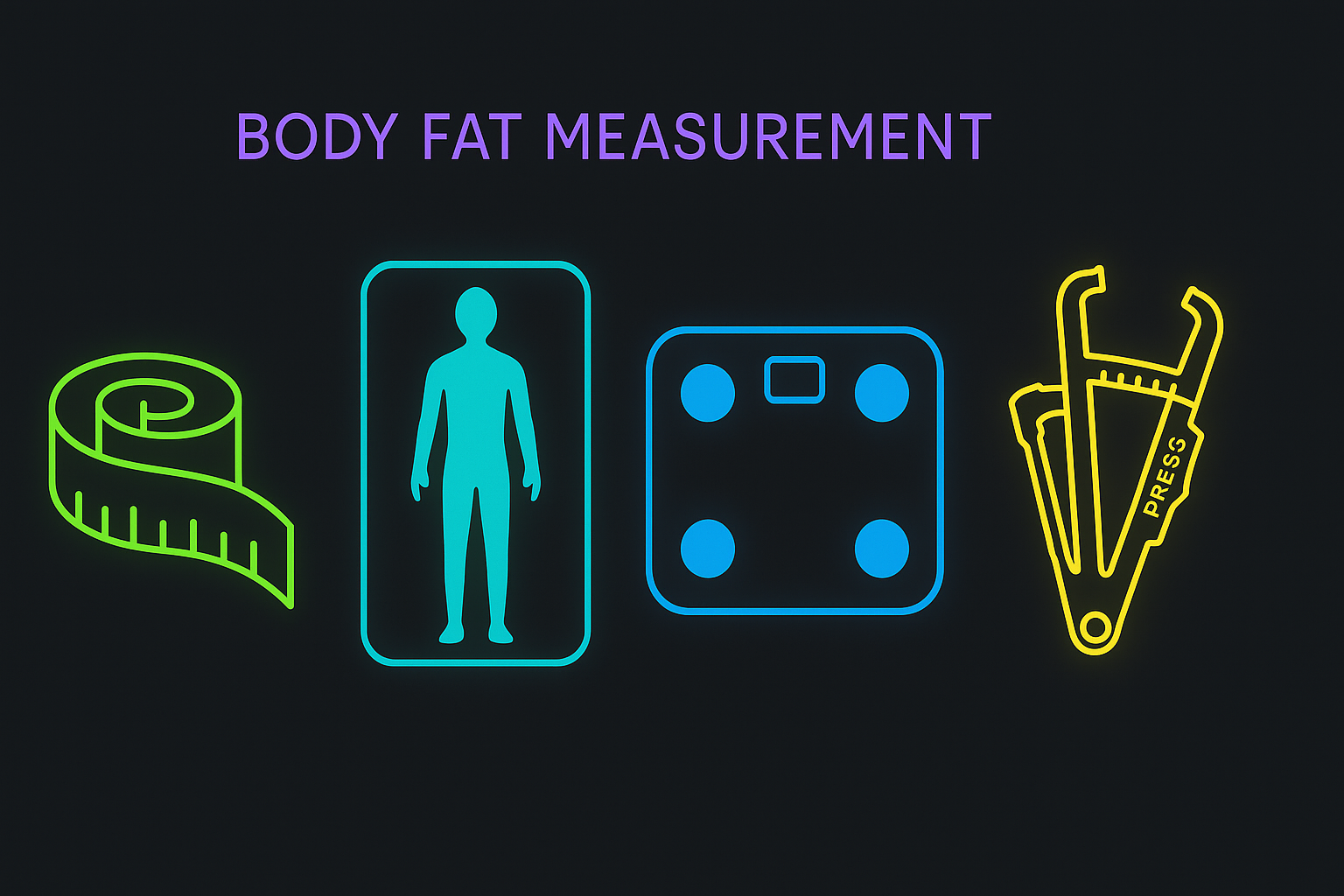
Why body fat percentage matters
Body fat percentage shows how much of your weight comes from fat tissue. It gives a clearer picture than weight alone because it separates fat from muscle, bone and water.
Different body fat levels can be associated with:
- metabolic health
- athletic performance
- energy balance
- muscle loss or gain
But not all measurement methods are equally accurate or accessible. Let’s break them down.
1. US Navy body fat formula (tape measurement)
This is the method used on this site. It estimates fat percentage using:
- neck
- waist at navel
- hips (for women)
- height
It is fast, free and suitable for long-term tracking. But it is still an estimate and depends on measurement consistency.
Accuracy
Medium. Typically within 3–5% of medical results when measured correctly.
2. Skinfold calipers
A trainer pinches specific skin areas (triceps, abdomen, thigh, etc.) with a caliper. The thickness of the “skin + fat” fold is entered into a formula.
Strengths
- Common in gyms
- Useful for tracking changes
- Inexpensive
Limitations
- Needs a trained person for accurate results
- Not ideal for people with high body fat
3. Bioelectrical Impedance (smart scales)
Many home scales send a tiny electrical current through the body. Fat conducts electricity differently than muscle, so resistance is used to estimate fat percentage.
Strengths
- Very easy to use
- Good for tracking trends
- Available in consumer devices
Limitations
- Day-to-day fluctuations can be large
- Affected by hydration and food intake
4. DEXA scan (dual-energy X-ray absorptiometry)
DEXA is the gold standard for body composition. It uses low-dose X-ray imaging to differentiate:
- fat mass
- muscle mass
- bone density
Accuracy
Very high — usually within 1–2% margin of error.
Limitations
- Expensive
- Requires a medical or sports science facility
5. Bod Pod (air displacement plethysmography)
This device uses air pressure changes to calculate body volume. Combined with weight, it estimates fat percentage.
Strengths
- Quick
- Reasonably accurate
Limitations
- Not widely available
- Expensive to access
6. Underwater weighing
Once considered the standard, this method weighs a person underwater to estimate body density.
Strengths
- Good accuracy
Limitations
- Uncomfortable
- Requires special equipment
Which method is best?
It depends on your goal:
- Daily tracking: smart scale or US Navy formula
- Monthly tracking: calipers or US Navy formula
- Highest accuracy: DEXA scan
Takeaway
No method is perfect, but most people don’t need perfect accuracy. The most important thing is consistency: using the same method over time to see real trends in your body composition.
If you want a quick and free estimate, try the calculator on this site.